


According to Rakuna’s internal research, 67% of respondents confirmed that they often spent from 30 minutes to 2 hours on scheduling interviews. If recruiters or coordinators have too many interviews daily, this task will consume a lot of their time and energy. Therefore, finding the best way to optimize the interview scheduling process to improve recruiters’ productivity is essential. Let’s learn the best tips to schedule interviews more efficiently.
Challenges for Recruiters When Scheduling Job Interviews
Back-and-Forth Emails and Calls
Constant communication is often needed to ensure the availability of both interviewers and interviewees. For example, traditionally, you will have to ask for the available time of the interviewers, and then you need to email or phone the interviewees to determine which of those time slots is ok for them. This process seems simple but can be quite time-consuming and prone to errors . Moreover, it can be more complicated if a hiring team member or candidate wants to change or cancel his/ her schedule; the scheduling process will need to be restarted from scratch.
Logistics Planning for Interviews
Handling logistics for the interview is a must for any recruiter to ensure a smooth candidate experience. To prepare for a face-to-face interview, recruiting coordinators must carefully prepare, including selecting suitable rooms/ spaces with the appropriate number of chairs and equipment (if needed) and clear instructions on driving/ traveling to the interview site. Besides, if there is reimbursement for travel costs, recruiters should also provide candidates with clear instructions on how to book or get reimbursement. If recruiters leverage video interviews instead, they still need to ensure all technical equipment works such as a stable internet connection, a professional interview background, a working microphone, a working speaker, etc.
Send Reminders and Confirmations Before the Interview
Sending reminders or confirmations to candidates and interviewers about the interview is an important step to improve the candidate experience and ensure the interview occurs as planned. However, according to IBM research, 20% of all job applicants feel unclear about the hiring process. Thus, recruiters should find ways to communicate with candidates effectively by leveraging the use of technology.
5 ways to Optimize Your Interview Scheduling Process
Contact Your Hiring Teams for Their Available Time First
The best way to ensure every interview is under control is to contact your hiring teams beforehand to ask them for their available time slots. This process can be optimized with the support of technology. Using Rakuna interview scheduling software, you can check all hiring members’ availability with simple clicks. This could be greatly helpful if you have large interview events with multiple stakeholders and save your valuable time.

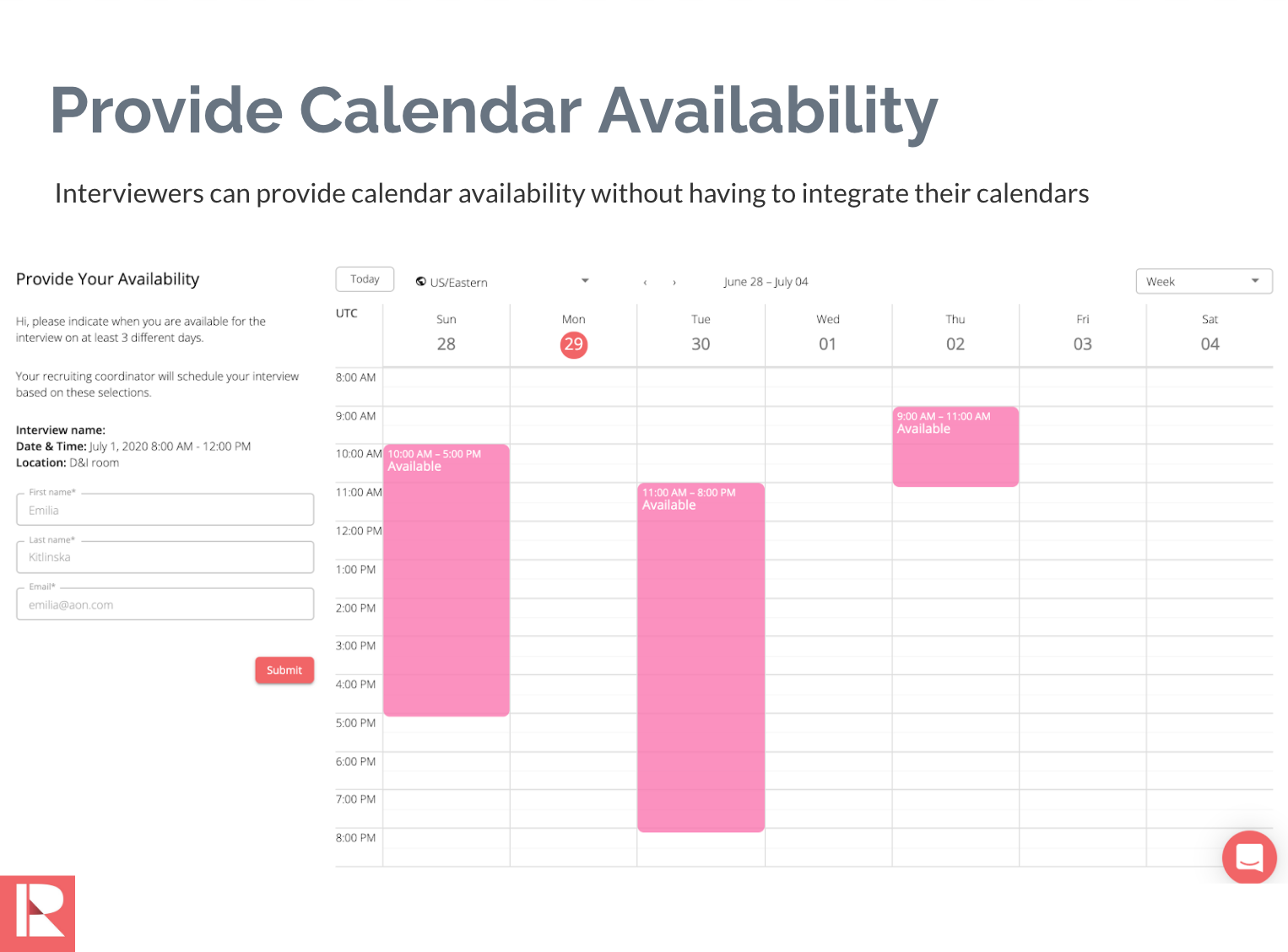
Photo source: Screenshot from Rakuna Interview Scheduling Software
Let Your Candidates Self-schedule Based on Available Time Slots
It is a common practice that in the interview, recruiters will arrange the specific time and location for interviewees to come. However, why don’t we let the candidates choose the suitable time for their interviews depending on the available time slots of the hiring teams? This is a great way to show the respect towards interviewees and enhance candidate experience. Here are some solutions for your consideration to optimize the interview scheduling process without wasting time on back-and-forth emails:
- Google Calendar: Since most Internet users are familiar with Google applications, Google calendar is easy to get access to. Candidates can quickly confirm their attendance through the calendar’s invitation from recruiters.
- Rakuna’s interview scheduling software: Not only does this software help candidates book the slots with interviewers easily based on available time slots, but it also automates the communication process by sending candidates invitation letters as well as reminders automatically. Rakuna’s interview scheduling tool is superior to other commonly used free tools in its flexibility to allow easy scheduling for all types of interviews, whether it is one-to-one in-person or video interview, panel, back-to-back, or assessment days with multiple interviews concurrently.
- Calendly: This is a free useful scheduling software for teams that provides recruiters with many automated functions. For example, it allows you to book unlimited meetings and interviews with others, then connect your calendars automatically to see whether you are available at the mentioned time or not. However, the tool limits you to use with just one type of meeting instead of multiple meeting types like one-on-one, round-robin, collective, and group meetings, assessment days, etc.
Allocate Time for Each Interview Properly


Depending on the different types of interview formats and steps in the recruitment process, you should indicate a specific duration for each interview to control time effectively.
- A phone interview is the first step in the hiring process, and it screens candidates’ CVs and backgrounds, so the ideal time for each phone interview should be around 15 to 30 minutes.
- In-person interviews is one of the most common interview formats for businesses. It usually takes 3- 5 minutes for each question for this type of interview. As a result, a face-to-face interview at the tech giants such as Google, Facebook, etc, often lasts from 30 to 60 mins, with the average questions from 6 to 10.
- Group interviews could be regarded as one of the best ways employers can see how their potential candidates communicate and react to each other. Based on the number of interviewees for each group, this type of interview usually lasts 45 to more than 60 minutes.
Moreover, leaving some buffer time during the interviews is necessary to keep the interview team’s spirit up. Depending on the number of interviews, recruiters should spend at least 10 to 15-minute breaks.
Build a Structured Set of Interview Questions
A set of strong and relevant interview questions is powerful for your company to discover the candidates’ potential. These questions can be specific questions about interviewees or general situational questions to learn more about their personalities and their skills, etc. Based on the job requirements of a position, you should customize the questions and make a list to ask the attendees carefully. Here are some recommendations for you besides some basic background interview questions:
Attention to Details
- Which tools do you use to keep track of your schedules, workflows, tasks, etc?
- If your boss gives you a very close deadline for a task, would you formulate a plan or carry it out immediately?
Behavioral Questions
- What does success mean to you? What is your plan to achieve it?
- What roles do you often take in a group meeting or discussion? What are its pros and cons?
Critical Thinking
- If you find a brilliant solution that saves the company a lot of time and money, you quickly present it to your boss, but he does not understand it. What will you do?
- Have you ever made any hard decisions in a short time? What did you do, and how did it work?
Integrity
- Have you made any mistakes in your last job? What happened, and what lessons did you learn from it?
- In your last job, what did you do if you didn’t think you could finish the task your boss gave you?
Handling Changes to Ensure Everyone Is on the Same Page
The interview process can be tricky with the involvement of different stakeholders like interviewers, interviewees, travel agents, receptionists, etc. Thus, it is likely that changes in the schedule, such as rescheduling or cancellation, are highly error-prone and easily lead to miscommunications across different stakeholders. As a result, using technology software like Rakuna for a centralized platform to keep everyone informed of all changes automatically can be a life-saving solution.
In addition, the recruiter can also turn into a technical recruiter to optimize their interview scheduling process. Check out [Where To Find Right [Technical Recruiter] Micro Jobs](https://knowledge-bull.com/where-to-find-right-technical-recruiter-micro-jobs/ “Where To Find Right [Technical Recruiter] Micro Jobs”) for more information
Final Thoughts
Scheduling a job interview can be complicated, but it is also essential to show your company’s professional business culture to your employee-wanna-be. We hope this ultimate guide to scheduling a job interview gives you the necessary tips and ideas to achieve better results with your interview scheduling tasks.